
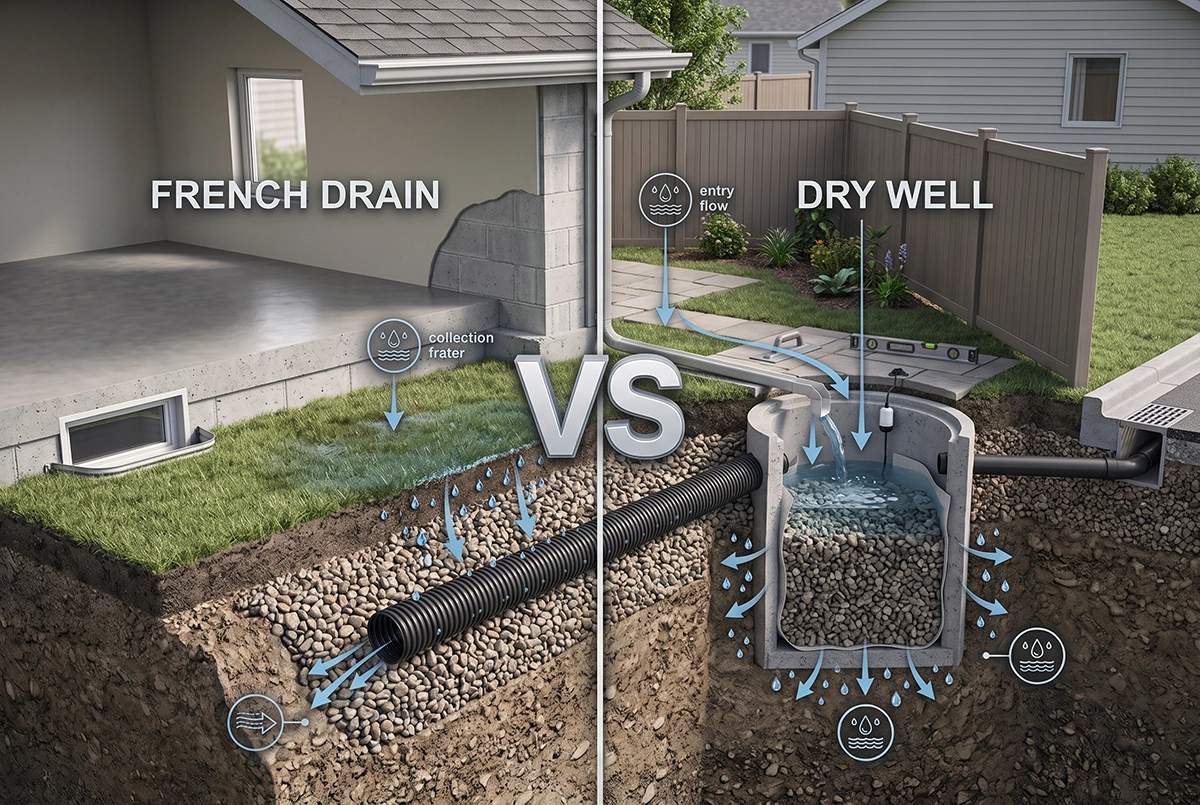
A small yard can have a large drainage problem, especially when a roof, patio and neighbouring grade concentrate rain in one place. In a dry well vs French drain comparison, neither system wins simply because it takes up less visible space. A dry well temporarily stores runoff and lets it soak into suitable soil. A French drain collects water along a trench and carries it towards an outlet.
Choose according to where the water comes from and where it can safely go. A concentrated source, such as a downspout, may suit underground infiltration if the site passes the necessary checks. A wet strip across the lawn may call for interception and conveyance. Some properties need both functions; others need grading or a different discharge arrangement before either system makes sense.
What Each System Does?
The two options solve different parts of the same problem. Understanding that distinction helps prevent an installation that collects water successfully but leaves it trapped underground.
How a Dry Well Handles Runoff?
A dry well is an underground storage space, commonly formed by a manufactured chamber or a stone-filled excavation. Water enters through a suitable collection and pipe arrangement, occupies the available void space and gradually passes into the surrounding ground. Its useful capacity depends on both storage volume and soil infiltration.
A dry well for yard drainage can leave much of the surface available for landscaping. However, the buried footprint is only part of the space requirement. The location must also accommodate separation from buildings and other site features, an inspection point, and access for construction and maintenance. A small lid does not mean the whole installation fits in that space.
How a French Drain Moves Water?
A French drain typically consists of a perforated pipe within a permeable trench. Water enters along that collection zone and moves towards a suitable discharge point. The design needs to intercept the actual wet layer; a trench in the wrong position can miss the water even when its pipe is clear.
For many narrow yards, a linear collection route can fit alongside a lawn or landscaped edge. Its limitation is the destination: collecting water is not the same as disposing of it. A pipe ending in saturated ground can leave the trench holding water. Surface ponding may also require a suitable inlet or grading change instead of relying only on water entering below ground.
Comparing the Options in a Small Yard
The most useful comparison is between the complete layouts, including their outlets and maintenance access. Consider how each option would function during rainfall and how it would recover afterwards.
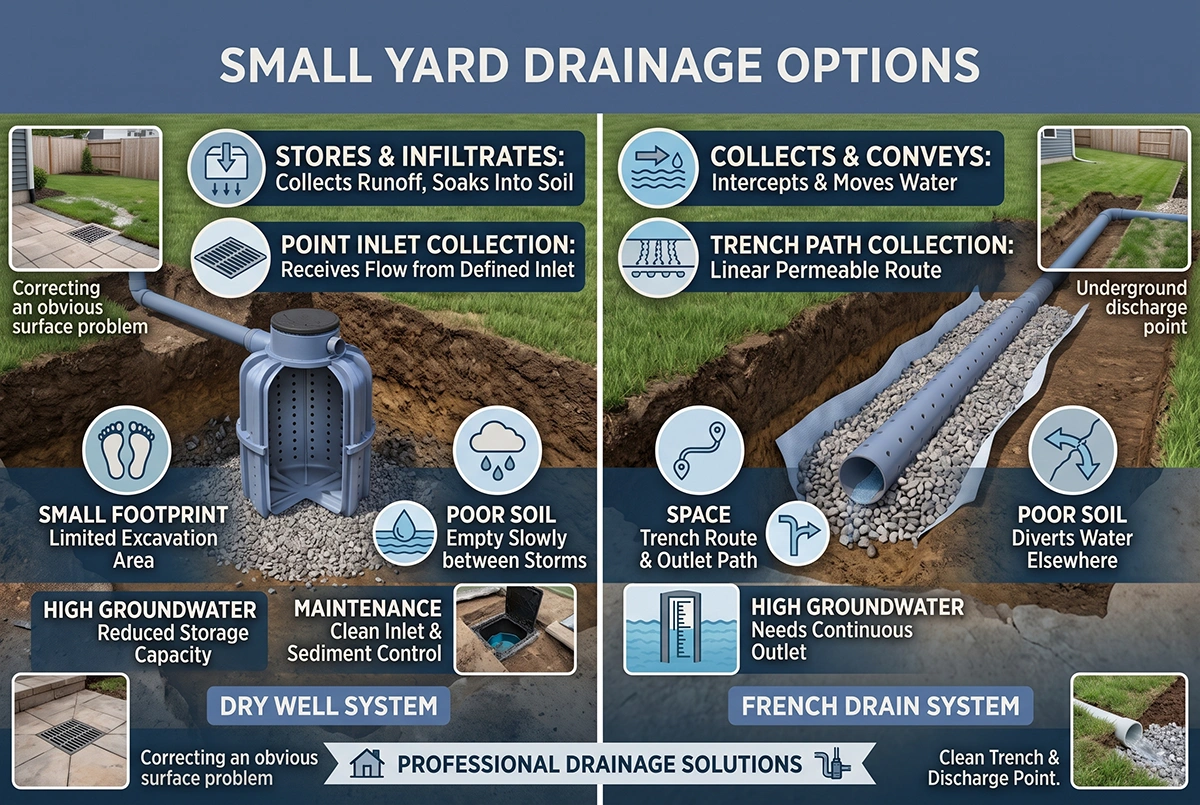
| Site consideration | Dry well | French drain |
|---|---|---|
| Main function | Temporarily stores runoff and infiltrates it into surrounding soil | Intercepts water along a route and conveys it towards an outlet |
| Typical collection pattern | Receives flow from a defined inlet or connected pipe | Collects along a permeable trench; surface inlets may be added where appropriate |
| Space to assess | Excavation footprint, required separations and access | Trench route, access and the space needed at the discharge destination |
| Slow-draining soil | May empty too slowly to recover storage between storms | May convey collected water elsewhere if a suitable outlet exists |
| High groundwater | Can reduce available storage and prevent effective infiltration | Can receive sustained inflow that the outlet must accommodate |
| Main maintenance points | Inlets, sediment control, inspection access and drainage time | Collection zone, accessible pipe sections and discharge point |
The best small yard drainage solutions often start with controlling unnecessary inflow. A disconnected gutter joint or a low spot beside a patio can repeatedly feed the same area. Correcting an obvious surface problem may reduce the underground capacity required, although it will not resolve every groundwater issue.
When a Dry Well Is the Better Fit?
A dry well is worth considering when runoff arrives at a defined point and the receiving soil can accept it. For example, a suitable roof-water connection can deliver flow to storage positioned away from vulnerable structures. The system then needs enough empty capacity before the next rainfall event.
This arrangement can suit a yard where an acceptable discharge route is unavailable but infiltration is feasible. The roof or paved area draining into it matters more than the total lawn area. A modest garden receiving runoff from a large roof may need more storage than its size suggests. Leaves and sediment also need to be intercepted before they obstruct the inlet or infiltration surfaces.
Before choosing a location, establish the conditions that determine whether it can work:
- The area contributing runoff and the amount the system is designed to handle.
- The measured infiltration performance at the proposed receiving depth.
- The position of groundwater, bedrock, buried services and nearby structures.
- The required separation distances and access for inspection or servicing.
- The route excess water will take when storage is full.
A percolation test can help assess infiltration, but a quick observation of topsoil is not a substitute for testing the receiving layer. The assessment should follow the method appropriate to the design and local requirements. Installing a deeper chamber without that information may reach less suitable ground rather than improve performance.
When a French Drain Is the Better Fit?
A French drain can be more suitable when water needs to be intercepted across a length of ground. Recurring wetness along the lower edge of a sloping lawn is different from one downspout discharging into a puddle. The trench must sit where it can collect that flow and connect to a destination capable of receiving it.
The route may fit within a narrow landscaped strip, but access still matters. Fences, mature roots, patios and buried services can limit excavation or prevent a continuous fall towards the outlet. A longer or deeper trench is not automatically more effective. Its alignment and outlet elevation have to work together.
If gravity discharge is impractical, a designed collection basin and sump pump may form part of another arrangement. Pumping adds equipment, power and maintenance requirements, and still requires an appropriate discharge destination. It does not make an unsuitable infiltration area suitable or remove the need to assess where the water will end up.
How Clay Soil and Groundwater Affect the Choice?
- A dry well in clay soil may drain too slowly, particularly where the receiving layer has low permeability. A larger excavation can add storage, but it does not improve the infiltration rate of the surrounding native soil. If stored water remains after one storm, there is less capacity available for the next.
- A French drain in clay soil can still move intercepted water towards a suitable outlet. That does not mean every clay yard benefits from one: water must be able to reach the trench, and the route must remain open. Filtration and construction details should match the soil rather than follow a single fabric recommendation for every property.
- The seasonal water table is another constraint. An excavation assessed during dry weather may experience very different conditions during spring thaw or prolonged rain. Soil and groundwater conditions vary between Toronto properties, so a neighbourhood label or a dry summer photograph cannot establish infiltration suitability.
Can a French Drain Connect to a Dry Well?
Connecting a French drain to a dry well can combine collection along a wet area with storage and infiltration at a suitable location. The arrangement works only if the receiving ground, available capacity and connecting elevations are appropriate. The chamber becomes part of the outlet design, not a shortcut around it.
The combined inflow needs to be considered. A system receiving both roof runoff and water intercepted along a trench may fill faster than one serving a single source. It also needs an overflow route for conditions beyond its design capacity. That route should avoid sending water back towards the house or creating a new problem on an adjoining property.
Where infiltration is unsuitable, attaching a dry well to the pipe can simply move the point where water accumulates. The right response may involve changing the collection area, reducing inflow or assessing another discharge arrangement. Connecting to municipal infrastructure requires confirmation that the proposed connection is allowed and appropriate.
Maintenance and Warning Signs
Common dry well drainage problems include blocked inlets, sediment accumulation, insufficient storage and unsuitable receiving soil. A system that once drained promptly but now holds water longer may need cleaning or investigation. Poor performance from the first substantial storm can also point to a design or site mismatch.
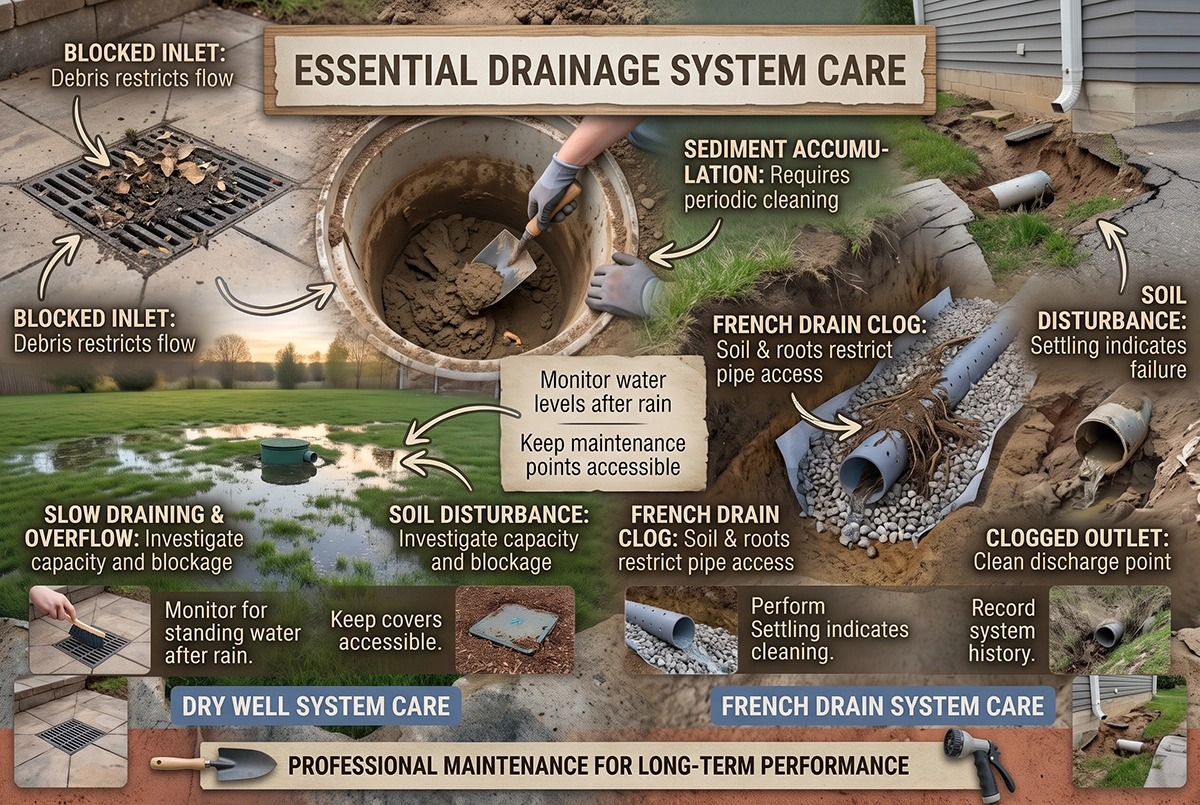
For either arrangement, keep accessible components clear and record changes after rainfall. Compare similar events where possible; unusually intense rain alone does not show that a system has failed. Useful observations include:
- Water remaining at an inlet after the surrounding surface has dried.
- Repeated overflow during rainfall the system previously handled.
- New settling, erosion or persistent wetness near the installation.
- A blocked, submerged or damaged discharge point.
Maintenance access should remain usable after landscaping is restored. Avoid burying inspection covers or placing permanent structures over components that need servicing. The contractor should explain what can be checked from the surface and when further investigation is needed.
Choosing a Layout for Your Property
Before deciding between a dry well or French drain, ask for a layout showing the source, collection area and final destination of the water. It should explain the soil evidence, available elevations, maintenance access and behaviour when the system reaches capacity. Compare those details before comparing excavation size.
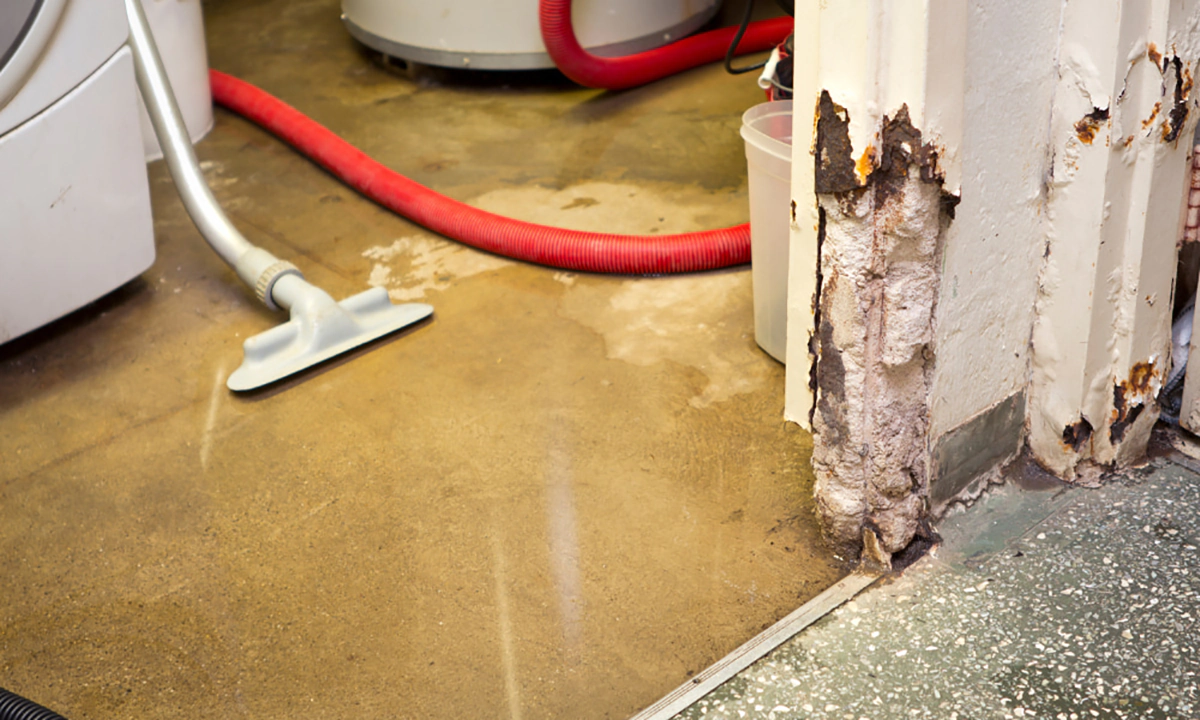
A wet yard and a leaking basement may be connected, but they should not automatically receive the same treatment. If water is entering at the building, an assessment of foundation waterproofing can help determine whether separate protection is needed. Leaquida can assess French drain and basement waterproofing options for Toronto properties; the proposed work should follow the diagnosed water source and site conditions.


 CLOGGED OR BROKEN WEEPING TILE