
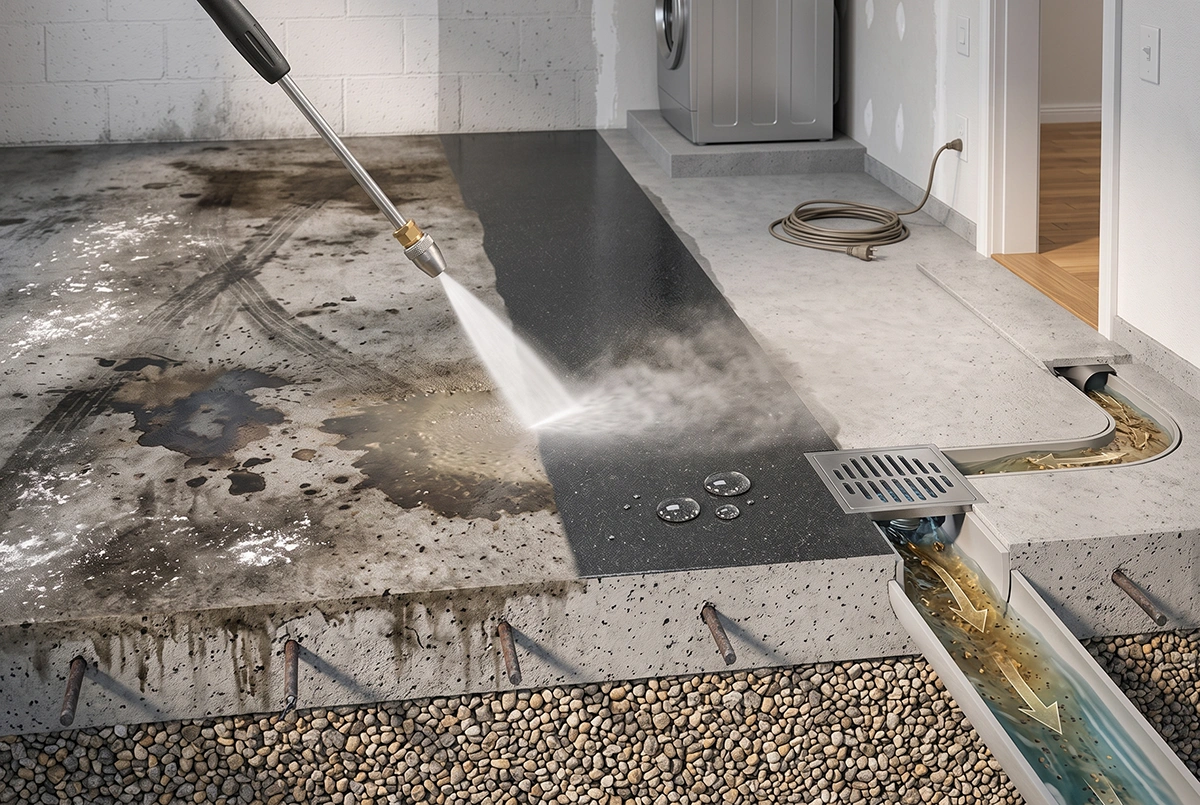
You can safely pressure wash garage floor concrete when the slab is sound, water has a controlled path out of the garage, and you use appropriate pressure and nozzle distance. Pressure washing is effective for road film, dirt, salt residue, tire marks, and surface grease, but old oil stains may need pretreatment and may not disappear completely.
Can You Pressure Wash a Garage Floor?
Yes. If you are asking can you power wash garage floor concrete, the main conditions are drainage, ventilation, and surface condition. A pressure washer can clean durable concrete efficiently, especially when a large floor has embedded grime that mopping will not remove.
Before starting, also check where outlets, extension cords, appliances, and wall penetrations are located. Water should never be sprayed toward electrical panels or open receptacles. If the garage connects directly to a finished interior space, create a dry boundary at the doorway so dirty rinse water cannot migrate into the house.
Avoid aggressive washing on crumbling, badly spalled, or very weak concrete until the slab is assessed. If the floor needs repair or replacement rather than cleaning, Leaquida also provides concrete floor installation in Toronto.
What Do You Need to Pressure Wash a Garage Floor?
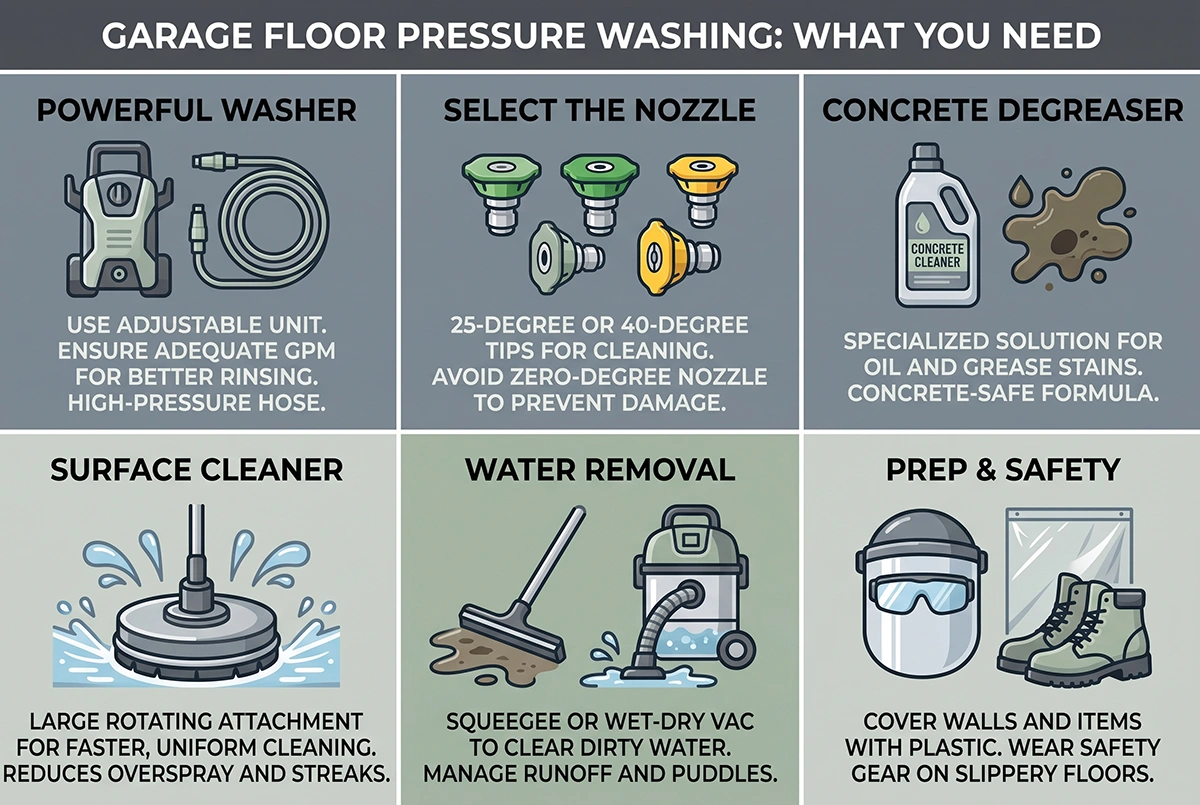
For pressure washing garage floor surfaces, prepare the equipment before bringing water inside. A basic setup includes a pressure washer, suitable hose, 25- or 40-degree nozzle, concrete cleaner or degreaser, stiff brush, surface cleaner, floor squeegee, and protective plastic for vulnerable finishes.
- A pressure washer with adjustable output or compatible nozzles.
- A wide fan nozzle for general cleaning; avoid starting with a zero-degree tip.
- A concrete-safe degreaser for oil stains and heavy grease.
- A surface cleaner for faster, more even passes with less overspray.
- A floor squeegee or wet vacuum to control dirty water.
- Plastic sheeting and tape to protect drywall, baseboards, outlets, and stored items.
Flow rate matters alongside PSI. A machine with adequate gallons per minute rinses loosened soil more efficiently, while a long high-pressure hose helps keep the washer itself outside when exhaust, noise, or space are concerns. Wear eye protection and slip-resistant footwear because the floor becomes slick once degreaser and rinse water mix.
How to Prepare a Garage Floor for Pressure Washing?
Empty the garage as much as possible, then sweep or vacuum loose grit. Scrape off thick deposits and pre-treat oil stains with a concrete cleaner or degreaser according to the product label. Give the cleaner time to work, but do not let strong chemicals dry on the slab.
Plan drainage before you start. Confirm that a floor drain is usable or that water can be pushed safely toward the garage door without entering the home. Cover drywall, baseboards, electrical components, and lower wall finishes that could be damaged by overspray.
For fresh oil, absorb as much liquid as possible before adding water. Thick grease should be scraped or lifted first so it does not spread across the slab. If local rules restrict detergent or oily wastewater from entering a drain or street, collect the rinse water with a wet vacuum and dispose of it appropriately.
How to Pressure Wash a Garage Floor Step by Step?
The safest approach to how to pressure wash garage floor concrete is to start gently and increase cleaning power only when needed. Test a small area first so you can see whether the nozzle and distance leave any etching.
- Apply the recommended concrete cleaner to greasy areas and agitate stubborn spots with a brush.
- Fit a wide fan nozzle and begin with the wand well away from the floor.
- Work in overlapping passes from the back of the garage toward the drain or open garage door.
- Use a surface cleaner on large open areas for more uniform cleaning and reduced spray.
- Rinse each section before detergent or loosened grime can dry back onto the concrete.
- Push remaining water toward the outlet with a floor squeegee or collect it with a wet vacuum.
If you prefer to power wash garage floor surfaces with a surface cleaner, keep the attachment moving at a steady pace. Pausing over one spot can produce visible cleaning rings or uneven results.
On a large garage, divide the slab into manageable sections. Complete the detergent, washing, and rinse cycle in one section before moving on. This keeps loosened residue from settling again and makes it easier to see where overlapping passes are needed. Finish with a low-pressure rinse that carries remaining cleaner toward the planned outlet.
How to Pressure Wash Without Getting the Walls Wet?
The practical answer to how to pressure wash garage floor without getting walls wet is to control the spray pattern and water direction. Protect the lower 30–60 cm of drywall and baseboards with taped plastic, keep the wand pointed down and away from walls, and avoid narrow nozzles near edges.
A surface cleaner is especially helpful because its shroud contains much of the overspray. Clean the centre of the slab first, then approach edges with lower pressure and a wider fan. Direct rinse water toward the floor drain or garage door rather than spraying along the wall-floor joint.
What PSI Should You Use on a Concrete Garage Floor?
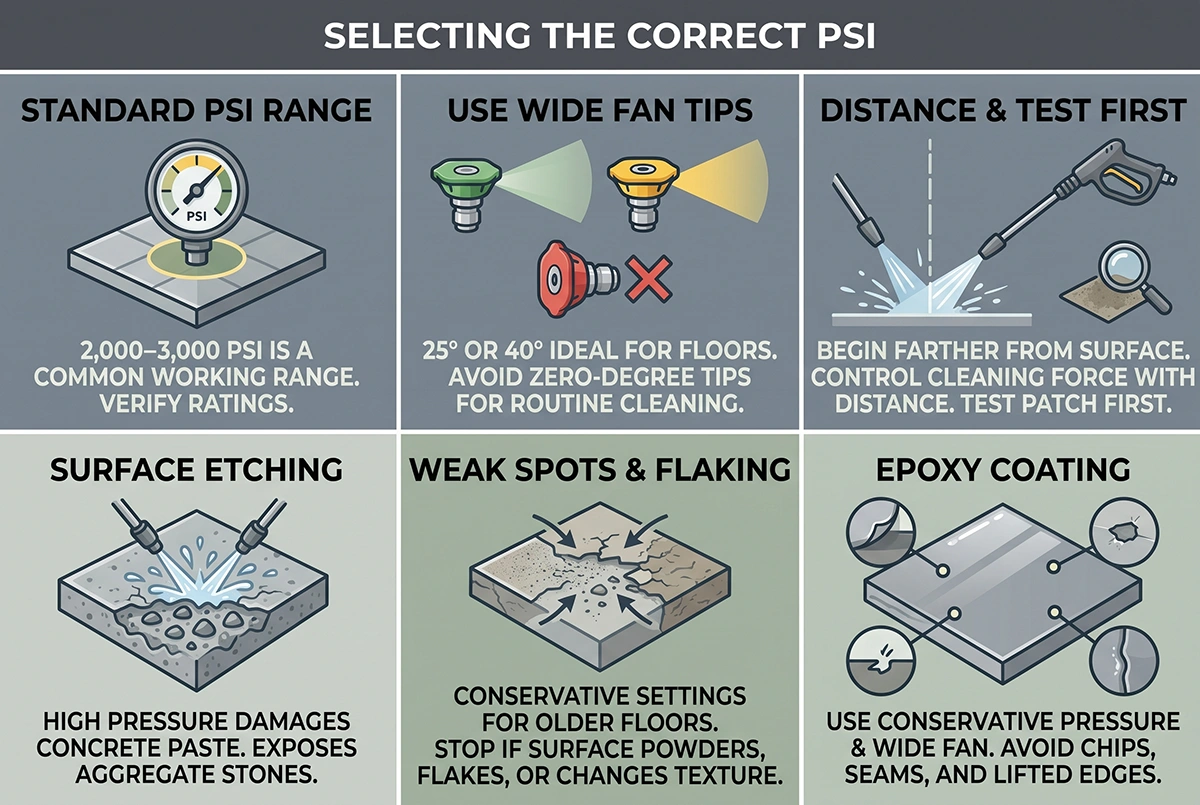
For a typical sound concrete garage floor, about 2,000–3,000 PSI is a common working range, but PSI alone does not determine aggressiveness. Nozzle angle, flow rate, distance, and dwell time all matter. Start farther away with a 25- or 40-degree nozzle and move closer only if the concrete is not cleaning effectively.
High pressure held too close can etch the paste at the concrete surface, expose aggregate, or worsen weak spots. A zero-degree nozzle concentrates force into a small point and is unnecessary for routine floor cleaning. Always follow the pressure washer and surface-cleaner ratings.
Older or previously repaired concrete deserves a more conservative test. Start below the machine’s maximum rating and use distance to control cleaning force. If the surface powders, flakes, or changes texture, stop and reassess. More pressure is not a substitute for the correct cleaner when the remaining mark is oil rather than attached dirt.
The table below summarizes a practical starting approach for common garage floor surfaces:
| Surface condition | Starting approach | Main caution |
|---|---|---|
| Sound, uncoated concrete | 2,000–3,000 PSI; 25° or 40° nozzle | Keep the wand moving and test first |
| Older or repaired concrete | Lower pressure, wider fan, greater distance | Stop if the surface powders or flakes |
| Intact epoxy coating | Conservative pressure and a wide fan pattern | Avoid chips, seams, and lifted edges |
What Does a Garage Floor Look Like Before and After Pressure Washing?
A realistic power wash garage floor before and after result is a noticeably brighter slab with less embedded dirt, salt film, tire residue, and surface grease. Joints and textured areas usually look cleaner because the water removes material that a mop leaves behind.
Deep-set oil stains may only fade. Oil can penetrate porous concrete, so even strong washing may leave a shadow after the surface grease is removed. Repeated degreasing, absorbent treatments, or professional cleaning may improve the appearance, but a perfect colour match is not guaranteed.
How Long Does a Pressure-Washed Garage Floor Take to Dry?
Drying time is usually several hours, but it varies with temperature, humidity, ventilation, slab porosity, and how much rinse water remains. Open the garage door when weather permits, improve air movement, and remove standing water with a squeegee or wet vacuum.
Do not return cardboard boxes, rugs, or moisture-sensitive storage until the floor is visibly dry. If you plan to coat, seal, or paint the concrete, follow that product’s moisture and curing requirements rather than relying on surface appearance alone.
Fans can speed drying after standing water is removed, but avoid blowing contaminated mist toward finished rooms. In humid weather, the slab can look dry at the surface while joints and pores still hold moisture. Give the floor extra time before placing rubber mats or tightly packed storage that could trap dampness.
Common Mistakes When Pressure Washing a Garage Floor
Most problems come from too much force or poor water control. Common mistakes include using a narrow nozzle too close to the slab, skipping degreaser on oil stains, spraying drywall, letting dirty water run into finished areas, and cleaning without a drainage plan.
Another mistake is expecting pressure alone to remove every stain. Mechanical force removes dirt, but oil and grease often require chemistry and dwell time. Working in smaller sections gives better control and helps prevent detergent or loosened grime from drying back onto the floor.
Professional Garage Floor Pressure Washing
Professional cleaning makes sense when the garage has heavy oil contamination, a large floor area, difficult drainage, fragile wall finishes, or concrete whose condition is uncertain. Commercial equipment and surface cleaners can provide more consistent coverage while technicians control wastewater and protect surrounding surfaces.
It is also useful before coating or repair work, because an evenly cleaned slab makes remaining cracks, scaling, and contamination easier to evaluate. The cleaning plan can then be adjusted so weak areas are not damaged simply to chase a cosmetic stain.

 CLOGGED OR BROKEN WEEPING TILE