

If your basement is damp or prone to flooding, a French drain can be an effective solution. This system helps manage water pressure around your foundation, keeping your basement dry and protecting your home’s structure. Here’s what you need to know:
- What it is: A French drain is a gravel-filled trench with a perforated pipe that redirects water away from your foundation.
- Types: Interior systems handle water that has already entered, while exterior systems prevent water from reaching the foundation.
- Costs in Canada: Interior systems cost $70–$120 per linear foot; exterior systems range from $100–$250 per linear foot.
- Lifespan: Exterior systems can last 30–50 years, while interior systems typically last 15–25 years.
- Key maintenance: Regularly flush the system, test sump pumps, and inspect discharge lines to prevent clogs or freezing.
French drains are particularly useful in Canadian climates, where freeze-thaw cycles and heavy snowmelt put extra pressure on foundations. Whether you choose an interior or exterior system depends on your home’s needs, budget, and the severity of the water issue.
French Drain and Foundation Waterproofing System
sbb-itb-5761e20
What Is a French Drain?
A French drain is a gravel-filled trench with a perforated pipe installed at the base of your foundation. This system is designed to collect groundwater from the soil around your home and direct it to a safe discharge point, like a sump pit or a municipal storm drain. The trench is typically filled with clear crushed stone (around 3/4 inch or 19 mm), allowing water to flow freely toward the pipe.
In Canada, you might hear it called a weeping tile or footing drain. These terms refer to the same drainage system, with the pipe placed at the foundation’s footing depth – where groundwater pressure tends to be highest.
What sets a French drain apart is its focus on subsurface water at the foundation level. Unlike surface drains (gutters, downspouts, or yard swales), which handle rainwater runoff above ground, a French drain tackles water below the surface. It’s also different from wall coatings like tar-based damp-proofing or elastomeric membranes. While those create a barrier on concrete walls, they don’t remove water from the soil. A French drain works by relieving the water pressure that would otherwise press against those barriers.
“A clogged, damaged or aging French drain can no longer move water away from the foundation properly, increasing the risk of moisture problems and basement leaks.” – Cynthia Pigeon
When installed correctly, using high-quality materials and geotextile filter fabric, a French drain can remain effective for over 30 years. That’s a big improvement over tar-based damp-proofing, which often lasts only 10 to 15 years in Canadian climates before cracking and losing its effectiveness.
How a French Drain Works
A French drain’s main purpose is to relieve hydrostatic pressure – the force exerted by water-soaked soil against your foundation. When soil becomes saturated, it pushes against basement walls and floors, forcing water through even the tiniest pores in the concrete. A French drain prevents this by intercepting groundwater at the foundation’s base and diverting it away before the pressure becomes too much.
Here’s how it works: water seeps into a trench filled with gravel, flows into a perforated pipe, and is directed either to a sump pit – where a pump moves it away from the house – or to a gravity-fed outlet that carries it downhill to a municipal drain. The gravel plays a dual role: it channels water effectively while filtering out soil particles to prevent clogs.
There are two types of systems used in basement waterproofing:
- Exterior systems: These stop water before it reaches the foundation, reducing the pressure on basement walls.
- Interior systems: These handle water that has already made its way inside, redirecting it to prevent damage.
“Interior systems usually manage water after it enters, while exterior systems aim to block and redirect it before it reaches your foundation.” – Homeowner.ca
In Canada, proper discharge line management is critical for system reliability. Freeze-thaw cycles can stress foundation walls, while rapid spring snowmelt can overwhelm poorly designed systems. For sump pump discharge lines, they need to extend at least 1.2 to 2 metres (4 to 6 feet) from the foundation to avoid freezing during cold weather. Exterior systems also require excavation below the frost line, which makes them more complex and costly to install in colder regions.
Types of French Drains for Basements
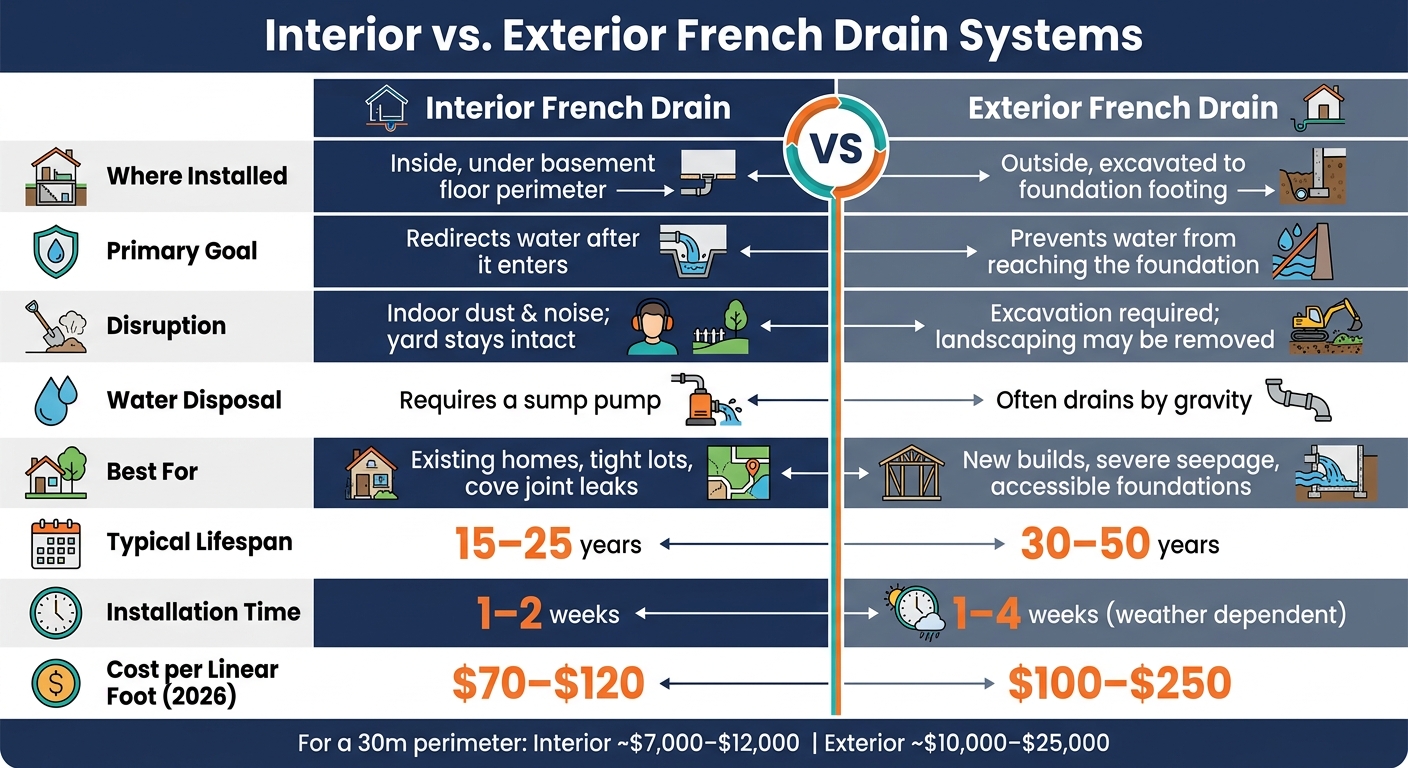
Interior vs. Exterior French Drain: Side-by-Side Comparison
When it comes to French drain waterproofing, you’ve got two main options: interior and exterior systems. Each tackles water at a different stage, so the right choice depends on your home’s layout, budget, and how bad the water issue is.
Interior French Drain System
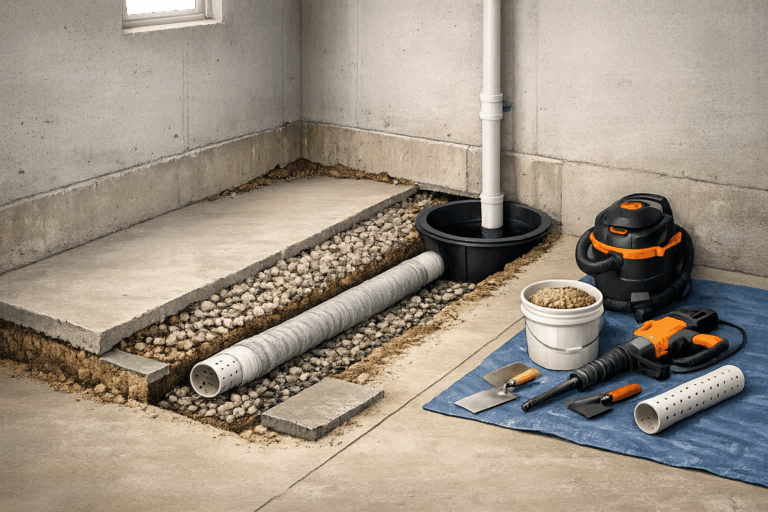
An interior French drain is installed along the inside perimeter of your basement, right at the base of the foundation walls. To set it up, contractors dig a trench in the concrete floor, place a perforated pipe on a gravel bed, and then cover it back up. This pipe directs water to a sump pit, where a sump pump moves it away from the house.
This system is ideal for dealing with water that seeps in through the cove joint (where the wall meets the floor). It’s often the go-to solution for homes in Toronto and nearby areas, especially when outdoor excavation isn’t an option due to structures like decks or tight property boundaries. Some modern systems even include features like wall flanges or drainage membranes, which catch water running down walls and guide it straight into the drain instead of letting it pool on the floor.
“Interior drainage does not prevent water from entering the foundation; it manages water after entry, keeping the basement floor dry by giving groundwater a controlled path to the sump pit.” – The Basement Guide
However, if your home has a monolithic foundation – where the floor and footing are poured as one piece – digging into the floor can harm the footing. In such cases, a surface-mounted baseboard drainage system is a safer alternative.
Exterior systems, on the other hand, tackle the problem before water even reaches your walls.
Exterior French Drain System
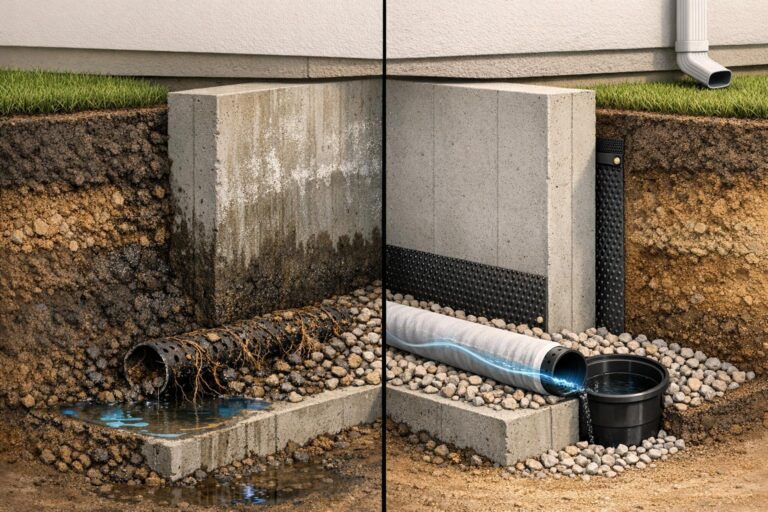
An exterior French drain is installed outside, right down at the foundation footing. This involves digging out the soil around the foundation, applying a waterproof membrane to the exterior wall, laying a perforated pipe (often wrapped in a filter sock to block sediment), and backfilling with gravel. Unlike interior systems, this method prevents water from building up against the foundation in the first place. The water is then carried away, usually by gravity, to a drywell, catch basin, or storm sewer.
By addressing hydrostatic pressure directly, exterior systems provide more comprehensive protection. They’re especially suited for new builds, homes with significant wall seepage, or situations where major landscaping work is already planned. That said, the process is more invasive – excavation can disrupt landscaping – and in Canada’s colder climate, the system needs to be installed below the frost line to remain effective. On the plus side, exterior systems typically last longer, with a lifespan of 30 to 50 years, compared to 15 to 25 years for most interior systems.
Here’s a quick side-by-side comparison to help you decide:
| Feature | Interior French Drain | Exterior French Drain |
|---|---|---|
| Where it’s installed | Inside, under the basement floor perimeter | Outside, excavated to the foundation footing |
| Primary goal | Redirects water that has already infiltrated | Prevents water from contacting the foundation |
| Disruption | Indoor dust and noise; yard stays intact | Excavation; landscaping may be removed |
| Water disposal | Requires a sump pump | Often drains by gravity |
| Best for | Existing homes, tight lots, cove joint leaks | New builds, severe seepage, accessible foundations |
| Typical lifespan | 15–25 years | 30–50 years |
At Leaquida Waterproofing, both interior and exterior systems are available. Pricing starts at $70–$120 per linear foot for interior work and $100–$250 per linear foot for exterior installations, depending on the scope of the project and soil conditions.
Key Components of a French Drain System
Understanding the main parts of a French drain is critical for effective basement waterproofing, especially in Canada’s challenging climate. You can find more expert advice in our waterproofing articles. Each component plays a specific role, and getting them right can mean the difference between a system that lasts for decades and one that fails prematurely.
The perforated pipe is the core of the system. For foundation drainage, rigid PVC is the top choice over flexible corrugated pipe. PVC is far better at withstanding deep soil pressure and surviving Canada’s harsh freeze-thaw cycles. While corrugated pipe may cost less, it tends to trap sediment, which reduces water flow over time. A crucial detail during installation is ensuring the holes in the pipe face downward. As Mike Thompson, a Master Plumber, notes:
“The most common DIY mistake is installing perforated pipe with holes facing up. This only catches water already in the trench. With holes down, rising groundwater enters the pipe before flooding your yard.”
The gravel bed surrounding the pipe is key to creating a fast, efficient drainage path. The ideal material is ¾-inch clear crushed stone, such as granite or limestone. “Clear” means the stone is free of fines or dust, which could clog the system. Avoid pea gravel, as it compacts too easily, and steer clear of recycled concrete, which can degrade over time and reduce efficiency.
Filter fabric, also known as geotextile, is another critical layer that wraps around the gravel and pipe. This fabric prevents clay and silt – common in many areas, including the Greater Toronto Area – from clogging the system. Non-woven geotextile (like Typar) is the best choice because woven fabric restricts water flow. The numbers speak for themselves: a system with high-quality filter fabric can last 30 to 50 years, while skipping this step can lead to clogs within 5 to 10 years.
When gravity alone isn’t enough to divert water, an active solution steps in. A sump pit and pump is used to handle the overflow. The drain directs water into the pit, and the pump moves it out through a discharge line. In Canada, where winters can be unforgiving, the discharge line must be sloped and either insulated or buried below the frost line to prevent freezing – especially during spring thaw. Installing a sump pit and pump typically costs between $800 and $1,500.
Lastly, clean-out access points are a smart addition to the system. These are especially useful in areas where iron ochre, a reddish-orange bacterial sludge found in some Canadian soils, can clog drains over time. Clean-outs make it easier to flush the system with high-pressure water, avoiding costly repairs later. Adding these during installation is a small investment that pays off in the long run.
Here’s a quick summary of these components and their specifications:
| Component | Recommended Spec | Why It Matters |
|---|---|---|
| Pipe | 4″ rigid PVC (SDR 35) | Resists crushing, ensures smooth flow, handles freeze-thaw |
| Gravel | ¾” clear crushed stone | Provides maximum drainage, won’t compact or degrade |
| Filter Fabric | Non-woven geotextile (e.g., Typar) | Prevents clogging from clay/silt, extends system lifespan |
| Sump Pit & Pump | Airtight lid; proper discharge | Manages water when gravity drainage isn’t enough |
| Discharge Line | Sloped; below frost line or insulated | Prevents freezing during Canadian winters |
| Clean-out Ports | Installed at bends and intervals | Allows for flushing, crucial in iron ochre-prone soils |
Signs You Need a French Drain
Basement water troubles don’t usually appear overnight. They tend to creep in, often giving subtle hints like moisture around the wall-floor joint. Spotting these signs early can help you address groundwater problems with a French drain system before they get worse.
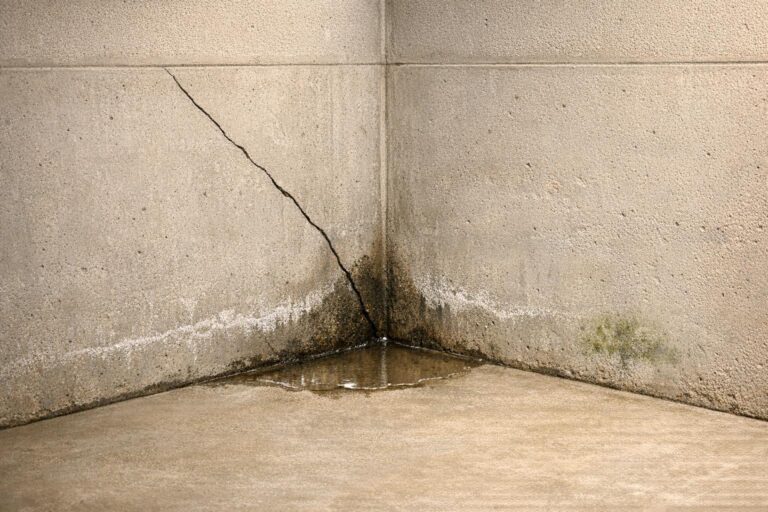
The clearest warning sign? Water pooling at the wall-floor joint. This is the seam where your foundation wall meets the concrete slab. If you notice a damp line or wet patch there after heavy rain or when the snow melts, it’s a strong clue that hydrostatic pressure is pushing groundwater into your basement. A French drain is specifically designed to tackle this issue by redirecting water away from your foundation.
Another clue that often goes unnoticed is efflorescence. Those white, powdery streaks on your foundation walls might look harmless, but they tell a deeper story. As Homeowner.ca explains:
“Efflorescence is typically a sign that moisture is moving through masonry and leaving salts behind as it evaporates.”
A musty smell in the basement is another indicator. Even if no water is visible, a persistent odour after rainfall often points to hidden seepage behind the walls. Here’s a quick test: tape a piece of plastic sheeting tightly to the wall for 24 hours. If moisture collects on the wall side, it’s a drainage issue. If it’s on the room side, the problem is condensation. Either way, further action is needed to address the root cause.
Lastly, take note of your sump pump’s activity. If it runs non-stop during storms or struggles to keep up, your drainage system might already be overwhelmed. Overworking the pump not only signals an issue but can also shorten its typical 7- to 10-year lifespan. A French drain can ease the burden by intercepting groundwater before it even reaches the pump, helping it last longer and work more efficiently.
Spotting these signs early can save you from potential structural damage and costly repairs down the road.
Benefits of French Drain Basement Waterproofing
Once you’ve identified the warning signs of water issues, it’s worth exploring how French drain systems can benefit your home.
One major advantage is relieving hydrostatic pressure. When groundwater builds up in the soil around your foundation – especially during spring snowmelt or heavy rains – it creates pressure that can lead to cracks, bowed walls, or even floor heaving. French drains alleviate this by redirecting water away from your home, reducing the strain on your foundation. This is especially critical in Canada, where freeze-thaw cycles put extra stress on foundations every year.
Keeping your basement dry also improves indoor living conditions. Excess moisture is a leading cause of mould growth, and by stopping water seepage, you eliminate the damp environment mould thrives in. This not only protects your home’s structure but also safeguards your family’s health.
On the financial side, a well-installed French drain can increase your home’s resale value by 5% to 10%, particularly in flood-prone areas. Additionally, drainage repairs typically recoup 60–80% of their cost when selling your home. French drains are a low-maintenance solution, often lasting 20 to 30 years without needing electricity or moving parts. These financial perks complement the structural and health benefits already mentioned.
“Smart home improvements increase your comfort, solve problems, and build equity.” – HonestCasa
From a real estate perspective, a professionally installed French drain system with a transferable lifetime warranty can be a game-changer. It resolves water-related issues that might otherwise appear on inspection reports, giving buyers confidence and helping prevent deals from falling through.
Installation Process Overview
Understanding how the different types of French drains are installed can help you prepare for the work ahead and understand why the process takes as long as it does.
Interior French Drain Installation
For interior installations, the process starts with breaking up the concrete floor along the basement’s perimeter. A trench is dug near the foundation footer, where a bed of washed gravel is laid down. A perforated pipe, positioned with the holes facing downward, is placed to collect rising groundwater. This pipe channels the water to a sump pit, where it can be pumped out. Once the pipe is in place, the trench is filled, and the concrete floor is restored. Generally, this process takes one to two weeks to complete.
In comparison, exterior installations require more extensive digging and can significantly impact your yard.
Exterior French Drain Installation
Exterior installations involve digging down to the foundation footing, which is typically 1.8 to 2.4 metres (6–8 feet) deep. This requires heavy machinery and can disrupt landscaping. Before excavation begins, it’s critical to contact Ontario One Call at least five business days beforehand to have underground utility lines marked.
After excavation, the foundation walls are cleaned and coated with a waterproofing membrane. The trench is then lined with non-woven geotextile filter fabric – a step that shouldn’t be skipped. Without this fabric, clay and silt can clog the system within 5 to 10 years. A perforated pipe is laid in a gravel bed, wrapped in the fabric, and the trench is backfilled with soil graded to direct water away from the home. Depending on weather and site conditions, exterior projects can take anywhere from one to four weeks.
“A French drain is buried underground, so poor-quality materials can be very costly to replace… Investing in higher-quality materials can help extend the lifespan of your drainage system, often allowing it to perform effectively for 30 years or more.” – Cynthia Pigeon, Reno Quotes
These two methods illustrate the importance of choosing the right system for your home’s specific requirements.
| Feature | Interior French Drain | Exterior French Drain |
|---|---|---|
| Installation Time | 1–2 weeks | 1–4 weeks (weather dependent) |
| Power Required | Yes (sump pump) | No (gravity-fed) |
| Main Disruption | Basement floor | Landscaping and yard |
| 2026 Cost/Linear Foot | $70–$120 | $100–$250 |
Cost of Installing a French Drain
The cost of installing a French drain can vary significantly depending on the type of system and where you live. For 2026, interior systems are estimated to cost between $70 and $120 per linear foot, while exterior systems typically range from $100 to $250 per linear foot. For a home with a 30-metre perimeter, this translates to about $7,000–$12,000 for interior systems and $10,000–$25,000 for exterior systems, not including any additional features.
Exterior projects often come with higher price tags once you factor in extras. Repairs for foundation cracks, for instance, can cost $500 to $1,500 per crack. Add landscaping restoration and a waterproofing membrane, and the total can climb to $15,000–$35,000. Restricted access to work areas – common in cities like Toronto or Montréal – can result in a 20% to 30% surcharge due to the need for manual digging or specialized equipment like mini-excavators.
Other potential expenses include:
- Sump pit and pump installation: $800 to $1,500
- Storm sewer connection: $1,000 to $3,000 or more
- Municipal permits: $500 to $1,500
Even building permits alone can range from $100 to $1,000, depending on your municipality.
“A clogged, damaged or aging French drain can no longer move water away from the foundation properly, increasing the risk of moisture problems and basement leaks.” – Cynthia Pigeon, Reno Quotes
Another major factor is location. Cities like Toronto and Vancouver often have costs that are 1.3 to 1.5 times higher than the national average. It’s also wise to set aside a 15% to 20% contingency to cover unexpected issues, such as water damage or hazardous materials in older homes. To make an informed decision, aim to collect at least three written estimates. These should detail excavation depth, pipe type, and membrane brand to ensure you’re comparing quotes accurately.
Understanding these costs upfront is essential for planning your project and ensuring you’re prepared for any additional maintenance needed to protect your investment over time.
Maintenance Requirements
Keeping a French drain in good working order is all about regular upkeep. Maintenance plays a huge role in preserving the system’s efficiency, as emphasized during its design and installation. With proper care, a French drain can last anywhere from 20 to 40 years. But if you let things slide – like allowing fine soil particles to clog the gravel or filter fabric – it might fail in as little as 5 to 10 years. Regular maintenance not only extends its lifespan but also saves you from expensive repairs down the line.
One of the key tasks is annual flushing, particularly in areas with iron-rich soil. Iron ochre buildup can seriously hinder drainage, so keeping an eye on it is crucial. Installing cleanout access points every 15 metres (about 50 feet) makes high-pressure flushing much easier and avoids the need for digging things up. However, while flushing does a great job of removing sediment, it won’t fix structural problems like collapsed or misaligned pipes.
In addition to flushing, there are other simple but effective steps to keep your system in shape:
- Clear gutters and downspouts regularly: Clogged gutters can redirect too much water toward your foundation, which could overwhelm even a well-installed drain.
- Test your sump pump several times a year: Pour a bucket of water into the sump pit to ensure the pump runs and discharges correctly. If the pump is running non-stop or struggling during light rain, it could mean the system is under too much strain.
It’s also important to check the discharge point – the spot where water exits the system. Make sure it’s not blocked by debris, overgrown plants, or ice. In cities like Toronto, connecting foundation drains to the sanitary sewer is against the rules, so double-check that your system complies with local stormwater bylaws.
Here’s a quick reference table for common warning signs and what they might mean:
| Warning Sign | Potential Cause | Action Required |
|---|---|---|
| Standing water near foundation | Clogged pipe or saturated gravel | Flush system via cleanouts; check outlet |
| Musty basement smells | Slow drainage or moisture buildup | Inspect for iron ochre; professional flush |
| Sump pump running constantly | System overload or high water table | Check downspout extensions; test pump |
| Water at wall-to-floor joint | Hydrostatic pressure buildup | Professional assessment of pipe integrity |
| Visible pipe collapse | Soil pressure or poor-quality materials | Replace affected sections |
DIY vs. Professional Installation
Installing a French drain on your own might seem like a way to cut costs, but it requires careful precision. The trench usually needs to be around 30 centimetres wide and 45–60 centimetres deep, with a steady downward slope of at least 1%. Even small grading mistakes can lead to water pooling or system failure, which is why many homeowners prefer to leave this job to professionals.
DIY Considerations
Taking the DIY route involves more than just physical labour – it comes with legal and safety responsibilities. For example, digging near your home’s foundation without first contacting your local utility locating service could result in hitting a gas line or buried cable. In Canada, you can avoid this risk by calling Ontario One Call (1-800-400-2255) before starting any excavation work.
Skipping the permit process is another costly mistake. Failing to secure the necessary approvals can result in hefty fines.
“Fines for installing a French drain without a proper permit can cost you thousands of dollars per day of infringement.” – Angi
Material selection is another critical factor. While opting for cheaper agricultural pipe might save money upfront, it often lacks non-woven geotextile fabric or proper 19-mm clear crushed stone. These omissions can lead to clogs, undermining the drain’s effectiveness and negating any initial savings.
Considering these risks and challenges, professional installation often provides a more dependable solution.
Advantages of Professional Installation
Professionals bring the tools, expertise, and accountability that are hard to match with a DIY approach. This is especially important in Canada, where factors like clay-heavy soil, iron ochre, and freeze–thaw cycles can put extra strain on drainage systems. Pros typically use high-quality materials, such as rigid perforated pipe and ¾-inch clear crushed stone, and design systems that can last 30 years or more.
Another benefit is that professionals handle the paperwork. They’ll take care of municipal permit applications and ensure that discharge points meet local stormwater regulations.
Leaquida Waterproofing, for example, installs both interior and exterior French drain systems in Toronto and nearby areas, adhering to consistent standards for every project. Before signing a contract, make sure you get written documentation detailing the excavation depth, membrane type, and the amount of crushed stone to be used. Relying on verbal agreements alone is risky.
“Never rely only on a verbal agreement. A proper contract should clearly describe the full scope of work and the materials that will be used.” – Reno Quotes
Common Problems With French Drains
French drains, like any system requiring maintenance, can develop issues over time. Spotting these problems early is crucial to maintaining their functionality and avoiding expensive repairs. While a well-installed French drain can last decades, no system is completely free from wear and tear.
Clogging: The Most Frequent Issue
Over time, clogging becomes almost inevitable. Fine soil particles slowly infiltrate the perforated pipe and gravel bedding, diminishing the system’s drainage ability. If the filter fabric deteriorates, silt can bypass this protective layer, filling the system from within. Typically, sediment buildup begins to impact performance after 10–25 years, even though the system might last 20–40 years in total. Flushing the drain can sometimes help temporarily, but it won’t resolve issues like collapsed pipes or fully saturated gravel. In such cases, replacing the system is usually the only long-term solution.
Incorrect Slope: A Hidden Installation Error
French drains depend entirely on gravity to move water, so an incorrect slope can lead to failure. Even a slight grading error can cause water to pool inside the pipe instead of flowing toward the outlet. The system requires a minimum slope of 1% – a 1 cm drop per metre of pipe run. This issue is particularly problematic in clay-heavy soils, which are common in Ontario, as these soils don’t absorb overflow well.
“Gravity moves water through the pipe to a designated outlet.” – Mike Thompson, Master Plumber
Sump Pump Problems in Interior Systems
For interior systems, sump pump failure poses a significant risk. Sump pumps have moving parts that wear out over time, with most units functioning reliably for only 7 to 12 years. During heavy storms, power outages can render the pump useless, leading to flooding. A battery backup unit, costing between C$100 and C$300, can provide a safety net. Regularly testing the float switch – by pouring water into the pit every three months – can also help prevent unexpected failures.
Frozen Discharge Lines: A Canadian Winter Hazard
In Canada’s harsh winters, frozen discharge lines are a common issue. If the exterior outlet freezes shut, the sump pump has nowhere to send water, which can lead to burnout. To avoid this, the discharge point should be at least 3 metres from the foundation and positioned where ice buildup won’t block it. Inspecting the outlet every fall before the ground freezes can save you from a major headache in the spring.
Summary of Common Problems
| Problem | Main Cause | Prevention |
|---|---|---|
| Clogging | Sediment buildup, degraded filter fabric | Use quality filter fabric and modern perforated pipes |
| Incorrect slope | Poor grading during installation | Use a laser level and verify slope at multiple stages |
| Sump pump failure | Worn motor, float switch issues, power outage | Test the pump regularly, use a battery backup, replace every 7–12 years |
| Frozen discharge line | Cold winters, poor outlet placement | Position outlet 3 m+ from foundation; inspect seasonally |
Conclusion
A French drain is a dependable solution for keeping basements dry when it’s designed, installed, and maintained correctly. Whether you choose an interior system to handle water that’s already seeped in or an exterior system to protect your foundation from contact with water, both options can be highly effective.
To recap, exterior systems act as a shield for your foundation, while interior systems focus on managing water that has made its way inside. Both require high-quality materials and precise installation to function effectively over time. Regular maintenance is also a must to keep the system in good working order.
If you’ve noticed a persistent damp smell, humidity levels above 50–60% even with a dehumidifier running, or white salt deposits (efflorescence) at the base of your basement walls, these are clear indicators that action is needed.
Leaquida Waterproofing provides free on-site inspections and detailed, written estimates tailored to your foundation and soil type. Serving Toronto, Mississauga, Markham, Vaughan, Brampton, Oakville, and nearby areas, they also assist homeowners eligible for the Basement Flooding Protection Subsidy Program, which offers rebates of up to C$6,650. Take steps now to protect your basement before the next big storm.

 CLOGGED OR BROKEN WEEPING TILE