


Basement seepage after heavy rain is a common issue for Canadian homeowners, often caused by hydrostatic pressure, foundation cracks, poor drainage, or overwhelmed municipal systems. Ignoring seepage can lead to structural damage, mould growth, and costly repairs. Here’s what you need to know:
- Causes: Saturated soil, foundation cracks, clogged drains, or poor grading.
- Warning Signs: Damp walls, musty odours, mould, efflorescence, peeling paint, and water pooling.
- Fixes: Repair cracks (e.g., polyurethane injection), install interior drainage systems or sump pumps, and consider exterior waterproofing for long-term solutions.
- Costs: Repairs range from $500 for minor cracks to $25,000+ for extensive waterproofing.
- Prevention: Maintain gutters, improve grading, and install sump pumps or French drains.
Seepage is more than a nuisance – it can cause health risks and reduce property value. Addressing it early saves money and prevents further damage.
Water Seepage into Basement after Heavy Rain – DECIDE NOW – HOW TO FIX
sbb-itb-5761e20
Why Does Basement Seepage Happen After Heavy Rain?
When heavy rain saturates the soil around your foundation, the water has to go somewhere. Once the ground can’t hold any more moisture, that excess water pushes against your basement walls and floors, finding its way inside through weak spots like cracks or gaps.
Seepage often occurs when your drainage system can’t keep up. Foundation drains, also called weeping tiles, are meant to collect and redirect water away from your home. But if these drains are overwhelmed or your sump pump fails, water can sneak in through cracks in the foundation, basement walls, or even around windows and doors.
The slope of your property can make things worse. If your lot directs water toward your house instead of away, rainwater flows straight to the foundation. Add clogged or overflowing eavestroughs to the mix, and you’ve got even more water pooling near your basement walls. During heavy rainstorms or rapid snowmelt, these factors combine to increase the risk of seepage.
In some cases, municipal sewer systems can’t handle the extra water from heavy rain. When that happens, water may take the path of least resistance, entering your home through cracks, deteriorating mortar, or poorly sealed windows.
Understanding how these forces work together helps you pinpoint the causes of basement seepage.
Common Signs of Basement Seepage
Spotting the signs of basement seepage early can save you from expensive repairs down the road.
One of the clearest indicators is the presence of damp or wet patches on your foundation walls, especially after heavy rain or snowmelt. You might also notice water pooling in corners or along the perimeter of your basement floor. This often points to water seeping through cracks or an overwhelmed drainage system.
However, seepage doesn’t always come with visible water. A persistent musty odour can signal trapped moisture, even when water isn’t immediately apparent. This dampness creates the perfect conditions for mould growth, which thrives in areas where water seeps through cracks or poorly sealed joints.
Another clue is the appearance of white, chalky deposits on your walls, known as efflorescence. These mineral salts are left behind as water moves through concrete and evaporates. Similarly, peeling, bubbling, or blistering paint can indicate moisture pushing through from outside, becoming trapped and damaging the coating.
"Basement water problems only get worse over time, leading to costly damage and health risks from mould."
Don’t ignore cracks in your foundation walls – whether they’re vertical, diagonal, or horizontal. These cracks are common entry points for water. You might also spot rotting or warped window frames and baseboards, which can signal seepage from nearby walls or poorly draining window wells.
Water Stains and Damp Walls
Water stains and damp spots are telltale signs of trouble in your basement. After heavy rain, check for dark discolouration or cool, damp areas on your walls. These often appear near the floor or around cracks, where water is forced through weak spots in the concrete by hydrostatic pressure.
Even if the stains fade as the walls dry, the problem usually persists. Each rainstorm can send water along the same path, gradually worsening cracks and weakening the structure. In areas with freeze–thaw cycles, this process can speed up significantly.
Pay special attention to the cove joint – where the wall meets the floor. Moisture or warping here often points to water entering through lower foundation cracks rather than directly from the floor. This type of seepage requires immediate attention to prevent further damage.
Musty Odours and Mould Growth
A damp basement often comes with a distinct musty smell that’s hard to miss. This stale, earthy odour occurs as moisture lingers, creating a welcoming environment for mould spores to grow.
Mould, which can appear as black, green, or grey patches, is often found on walls, around windows, or near plumbing fixtures. Even if mould isn’t visible, the smell alone suggests moisture issues that could lead to its growth, posing potential health risks.
"Knowing the early warning signs of a basement water problem can prevent costly repairs and protect your home from long-term damage."
- Eco Seal Canada
While a dehumidifier can help reduce humidity and discourage mould growth, it’s only a temporary solution. Addressing the root cause of the seepage is critical to preventing recurring issues.
Efflorescence and Peeling Paint
If you notice a white, chalky residue on your basement walls, you’re likely seeing efflorescence. This occurs when water evaporates and leaves behind mineral salts, signalling that moisture is actively moving through your foundation – even if liquid water isn’t visible.
Peeling or bubbling paint is another red flag. This happens when water pushes through from the outside, becoming trapped behind the paint. Over time, the finish lifts, bubbles, and flakes off. You might also notice discolouration or a sticky texture in areas where drywall or plaster has absorbed moisture.
Before repainting or replacing damaged materials, make sure the underlying leak is fixed. For poured concrete walls, polyurethane crack injection is often the go-to solution. This method works by expanding deep within the crack, effectively sealing water pathways – even if the foundation shifts over time.
The Most Common Causes of Basement Seepage
In Canada, basement seepage after heavy rain is often linked to foundation cracks, poor exterior drainage, and worn-out waterproofing systems.
Building on earlier discussions about seepage symptoms, this section dives into the root causes. Each issue creates an entry point for water, and understanding these sources is key to stopping the problem from recurring.
Foundation Cracks
Cracks in your foundation are one of the most direct ways water can enter your basement. These cracks often develop due to your home naturally settling over time or the gradual weakening of concrete. Homes built before the 1950s are particularly vulnerable since they often lack modern reinforcements like proper footing or rebar. As concrete ages – over 100 to 200 years – it loses its structural strength, making older foundations more prone to cracking and water intrusion if not well maintained. Even minor cracks can allow water under pressure to seep inside.
Poor Exterior Drainage
When water isn’t properly directed away from your home, it can pool near the foundation and eventually seep into the basement. Clogged eavestroughs often cause gutters to overflow, sending water directly against your foundation. Similarly, downspouts that release water too close to the house or ground grading that slopes toward the structure can lead to persistent water accumulation. Regular maintenance, such as inspecting your home in the spring and fall, can help catch these drainage problems before they result in seepage.
Failing Waterproofing Systems
The state of your home’s waterproofing system plays a major role in preventing seepage. Over time, these systems wear down. Interior waterproofing solutions, such as crack sealants and moisture-resistant paints, need to be reapplied every 5–10 years.
"Waterproofing is crucial for basements to prevent water intrusion, mould growth, and structural damage. Interior waterproofing methods like sealants and vapour barriers help control moisture levels but don’t address the root cause."
- Tim O’Shea, The Build Pros
Older drainage systems, like French drains, are also prone to issues. These can become clogged, collapse, or crack over time. Ageing sump pumps, especially those without battery backups, may also fail during power outages caused by storms. Unlike basic damp-proofing, which only protects against soil moisture, full waterproofing systems are designed to handle hydrostatic pressure. However, when these systems degrade to the point of acting like damp-proofing, they can no longer hold back pressurised groundwater during heavy rainfall.
Is Basement Seepage After Rain a Serious Problem?
Basement seepage is more than just an inconvenience – it’s a problem that can spiral into serious health and financial challenges. Statistics show that over half of homes experience water-related issues, and 38% of Canadian homes display signs of dampness or mould. Even a small leak can quickly turn into a costly nightmare.
Here’s why: mould can start growing in as little as 24 to 48 hours on water-damaged surfaces. Once it takes hold, it releases allergens, irritants, and potentially harmful mycotoxins. These can cause symptoms like sneezing, skin rashes, red eyes, and even asthma attacks. If your basement is connected to your home’s ductwork, mould spores can travel through the air supply, affecting the entire house. This is especially concerning for finished basements that are used as bedrooms or living spaces, where mould can spread quietly and become harder to detect.
"In a basement that is seldom used and separate from the living spaces above, this may not present a great problem. However… basements are increasingly used as finished living and bedroom spaces. In these cases, moisture problems are not only annoying and uncomfortable, but can lead to significant health problems."
The financial impact of unchecked seepage is equally alarming. Repair costs can exceed $40,000, and most standard homeowners insurance policies don’t cover groundwater seepage or flooding. This means you could be left to shoulder the entire expense. Beyond financial strain, seepage can lead to structural damage, such as rotting wood headers, joists, sill plates, and columns. Ignoring these issues may compromise your home’s structural integrity and lead to even higher repair costs. Worse, insurers may deny coverage if mould growth is linked to poor maintenance or delayed repairs.
These risks highlight why addressing basement seepage promptly is so important. Ignoring the problem only increases the potential for costly and hazardous consequences.
How to Fix Basement Seepage
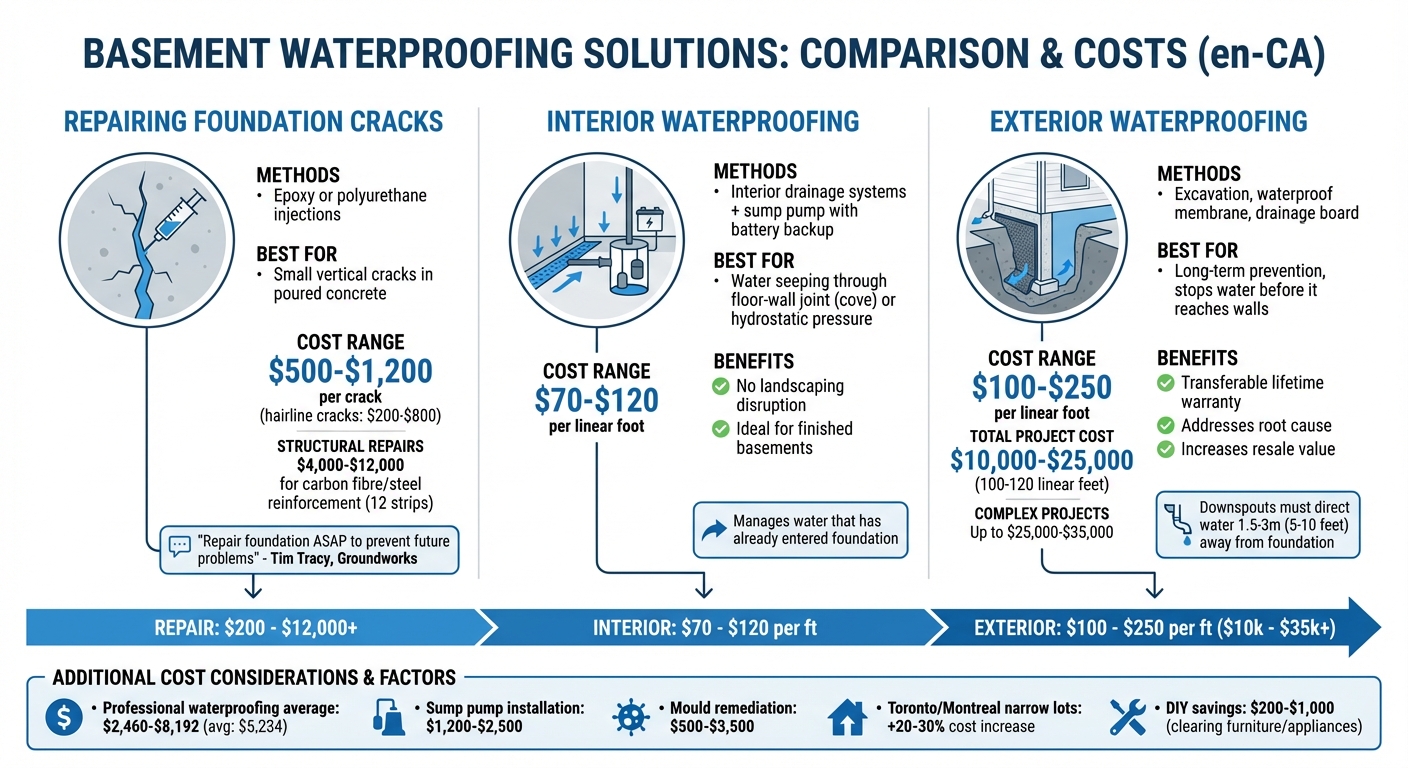
Basement Waterproofing Solutions: Costs and Methods Comparison
Once you’ve identified seepage in your basement, the next step is tackling the water entry points. The solution depends on where the water is coming from and how severe the issue is. Professionals typically focus on three main approaches: repairing foundation cracks, interior drainage systems, and exterior waterproofing.
Repairing Foundation Cracks
For small, vertical cracks in poured concrete foundations, epoxy or polyurethane injections are a common fix. These materials fill the cracks from the inside, creating a watertight seal that stops water from getting through. At Leaquida Waterproofing, the cost for repairing foundation cracks ranges from $500 to $1,200 per crack, depending on the size and how easy it is to access. If caught early, smaller hairline cracks can cost as little as $200 to $800 to repair.
"Repairing the foundation as soon as possible is the best way to ensure you won’t have additional problems in the future."
- Tim Tracy, Regional Manager, Groundworks
However, if cracks are wider than 6 mm (1/4 inch) or follow a "stair-step" pattern, this may point to structural movement rather than simple settling. In such cases, you might need carbon fibre or steel reinforcement strips to stabilize bowed walls. This type of repair can cost between $4,000 and $12,000 for 12 strips.
If sealing cracks doesn’t fully resolve the issue, interior solutions can help manage any remaining water.
Interior Waterproofing Solutions
When water seeps in through the floor-wall joint (known as the cove) or due to hydrostatic pressure, interior drainage systems can redirect it effectively without disturbing your landscaping. These systems involve installing drainage channels along the basement’s perimeter to collect water and direct it to a sump pump.
This method works well for finished basements because it manages water that has already entered the foundation rather than preventing it. Costs typically fall between $70 and $120 per linear foot. Most systems also include a sump pump with a battery backup to keep it operational during power outages, which are common during heavy storms.
For a more permanent solution that stops water before it even reaches your foundation, exterior waterproofing is an option.
Exterior Waterproofing Methods
Exterior waterproofing involves excavating around your foundation down to the footing, cleaning the walls, and applying a waterproof membrane along with a drainage board. This stops water from ever touching your basement walls, offering a long-lasting solution.
Although this method is more invasive and expensive – costing between $100 and $250 per linear foot depending on soil type and excavation depth – it addresses the root cause of seepage. For example, clay soils often require more intensive waterproofing measures. To further reduce the risk of seepage, ensure your gutters and downspouts direct water at least 1.5 to 3 metres (5 to 10 feet) away from the foundation.
While the upfront cost can be high, exterior waterproofing often comes with transferable lifetime warranties. This not only protects your home but can also boost its resale value.
How Much Does It Cost to Fix Basement Seepage?
Now that we’ve gone over how to fix basement seepage, let’s break down the potential costs involved. The price can vary significantly depending on the severity of the issue and the repair method chosen. Here’s a closer look at the expenses tied to various solutions.
Professional waterproofing services typically range from $2,460 to $8,192, with an average cost of $5,234. Smaller sealing jobs might start at $2,000, while more comprehensive systems that tackle both moisture control and mould prevention can climb to $5,000–$10,000.
For specific repairs:
- Fixing a single foundation crack costs between $500 and $1,500.
- Installing an interior drainage system is priced at $60–$120 per linear foot.
- Adding a sump pump can cost anywhere from $1,200 to $2,500.
If you’re in a city like Toronto or Montreal, homes on narrow lots may face an additional 20% to 30% increase in costs due to limited site access, often requiring manual labour for digging.
Exterior waterproofing is priced higher, ranging from $100 to $250 per linear foot. For a foundation spanning 100–120 linear feet, this means a total cost of $10,000 to $25,000, with more complex projects potentially reaching $25,000 to $35,000.
If moisture has lingered for some time, mould remediation may add $500 to $3,500 to your expenses. You can save $200 to $1,000 in labour costs by clearing out furniture and appliances beforehand.
On average, interior waterproofing projects cost about $3,000, while extensive exterior work averages around $7,000.
How to Prevent Basement Seepage in the Future
Once you’ve repaired basement seepage, the next step is keeping it from coming back. Routine upkeep and smart upgrades can help protect your home from future water issues.
Maintain Gutters and Improve Grading
Gutters and downspouts are your home’s first defence against water infiltration. To keep them working efficiently, clean them twice a year – once in the spring and again in the fall – to avoid clogs and overflow. Make sure your downspouts extend 1.8–2.4 m away from your house to direct water far from the foundation.
Proper grading around your home is just as important. The ground should slope away from your house at a minimum of 5% grade (about 15 cm over 3 m) to stop water from pooling near the foundation. If you notice areas where the ground has settled, add and compact soil to restore the slope.
Install Sump Pumps and French Drains
For added protection, consider installing systems designed to handle water that gets close to your foundation.
A sump pump is a reliable way to guard against water intrusion. A multi-pump system is even better, featuring a primary pump, a secondary pump for heavy water flow, and a battery backup to keep everything running during power outages – especially useful during storms. In Canada, over 142,000 homeowners have installed professional waterproofing systems that include these features.
French drains are another effective solution. These systems catch groundwater before it reaches your basement, channelling it to the sump pump. Installed beneath the basement floor, French drains work seamlessly to keep your space dry. To handle Canadian winters, components like IceGuard can prevent discharge lines from freezing, ensuring water flows out even in extreme cold.
These systems work hand in hand with regular maintenance to reduce water pressure around your foundation.
Leaquida Waterproofing Warranties and Monitoring
For long-term peace of mind, professional warranties and regular monitoring can make a big difference.
Many waterproofing companies provide warranties tailored to their services, including interior and exterior waterproofing as well as foundation crack repairs. For example, Leaquida Waterproofing offers coverage for a range of services, ensuring your home stays protected over the long haul. Routine inspections by professionals can catch issues like foundation cracks or failing systems early, preventing minor problems from turning into major flooding. Some contractors even provide free assessments to evaluate your basement and recommend solutions tailored to your specific needs.
When Should You Call a Professional?
If seepage continues despite basic repairs, it’s a clear sign of deeper issues that need professional attention.
You should reach out to a professional immediately if you notice any of the following: foundation cracks wider than 0.6 cm or spreading horizontally, water pooling deeper than 2.5 cm after a heavy rainfall, or walls beginning to bow. These are not just warning signs – they’re indicators of structural problems that require expert solutions.
In areas like the Greater Toronto Area, local conditions add another layer of complexity. With clay-heavy soils and frequent freeze-thaw cycles, these challenges are unique to the region. Leaquida Waterproofing, with over 20 years of experience, specializes in addressing these specific issues. Their services include drainage upgrades like perimeter French drains (using 10–15 cm perforated pipes) and regrading properties to maintain a 2% slope. They also install sump pumps with battery backups capable of redirecting 500–1,000 litres of water per storm and managing up to 2,000–4,000 litres per hour during heavy rainfall.
The numbers make a strong case for professional help. In Canada, professional waterproofing reduces the chance of recurring seepage by 90%, compared to just 40% for DIY solutions. In Toronto, homeowners face insurance claims that are 25% higher due to unresolved foundation issues, with repair costs typically ranging from $10,000 to $30,000. However, professional solutions can lower these costs by 30–50%. For instance, an Etobicoke homeowner who neglected minor seepage after heavy rain in 2023 ended up spending $15,000 on mould remediation. By contrast, Leaquida’s exterior membrane and French drain system would have cost around $8,000.
"A dry, structurally sound basement is one of the most important factors in maintaining your property’s safety, comfort, and value." – Leaquida Waterproofing
If you detect musty odours, mould, or persistent efflorescence, it’s crucial to schedule an inspection within 24–72 hours. Leaquida Waterproofing serves the entire GTA, including Mississauga, Markham, Vaughan, Brampton, and Scarborough, offering free assessments. Their solutions meet Ontario Building Code standards and come with transferable 25-year warranties. Acting quickly not only addresses current seepage problems but also reinforces long-term prevention strategies discussed earlier.
Conclusion
Basement seepage is not an issue to ignore. Whether it stems from foundation cracks, inadequate drainage, or deteriorating waterproofing, the effects can be costly and damaging. Left unchecked, it can result in mould growth, structural issues, and repair bills that can exceed C$10,000. If you notice signs of seepage, it’s crucial to address them right away. Routine upkeep – like cleaning gutters, improving yard grading, and scheduling professional inspections – can help prevent problems. However, if seepage continues, don’t hesitate to consult a professional. Taking action early can save you from bigger headaches down the road.
FAQs
Is my basement leak seepage or a sewer backup?
Basement seepage happens when water makes its way through foundation cracks or porous walls, often following heavy rainfall. On the other hand, sewer backups occur when wastewater flows back from municipal lines, usually because of blockages or overloaded systems.
Common signs of a sewer backup include unpleasant odours, discoloured or contaminated water, and sudden backups in drains or toilets. Seepage tends to happen more gradually. If you’re unsure about the cause, it’s best to call in a professional to evaluate and resolve the problem.
Can a dehumidifier fix basement seepage long-term?
No, a dehumidifier isn’t a permanent solution for basement seepage. While it can help manage moisture levels and improve the air quality temporarily, it doesn’t tackle the underlying issues causing the seepage. Problems like cracks in the foundation, poor drainage, or hydrostatic pressure need to be properly addressed through repairs and waterproofing to stop water from entering the basement in the first place.
Which repair is best: crack injection, interior drain, or exterior waterproofing?
When it comes to addressing basement seepage, the right repair method depends on both the cause and how severe the issue is. Here’s a quick breakdown of common solutions:
- Crack injection: Ideal for sealing specific foundation cracks that are causing leaks.
- Interior drains: A good choice for managing recurring seepage by redirecting water away from the basement.
- Exterior waterproofing: Best for tackling severe or long-term problems by addressing the source of water infiltration directly.
To figure out the most effective approach for your basement, it’s a smart idea to get a professional assessment tailored to your situation.
 CLOGGED OR BROKEN WEEPING TILE